Classic Art Auctions Valencia Ca Are They Still in Business
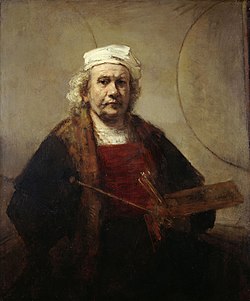


In European bookish traditions, fine art is developed primarily for aesthetics or creative expression, distinguishing it from decorative art or practical art, which also has to serve some practical function, such as pottery or near metalwork. In the aesthetic theories adult in the Italian Renaissance, the highest art was that which allowed the total expression and display of the artist's imagination, unrestricted by any of the applied considerations involved in, say, making and decorating a teapot. It was also considered of import that making the artwork did not involve dividing the work between different individuals with specialized skills, equally might be necessary with a furniture, for case.[1] Even inside the fine arts, there was a hierarchy of genres based on the amount of artistic imagination required, with history painting placed higher than still life.
Historically, the v main fine arts were painting, sculpture, architecture, music, and verse, with performing arts including theatre and dance.[2] In practice, outside educational activity, the concept is typically only applied to the visual arts. The sometime master print and drawing were included as related forms to painting, just equally prose forms of literature were to verse. Today, the range of what would be considered fine arts (in then far every bit the term remains in employ) commonly includes additional modernistic forms, such as moving-picture show, photography, video product/editing, design, and conceptual fine art.[ original research? ] [ stance ]
One definition of art is "a visual art considered to have been created primarily for artful and intellectual purposes and judged for its beauty and meaningfulness, specifically, painting, sculpture, cartoon, watercolor, graphics, and architecture."[three] In that sense, at that place are conceptual differences between the fine arts and the decorative arts or applied arts (these two terms covering largely the aforementioned media). As far as the consumer of the art was concerned, the perception of aesthetic qualities required a refined judgment ordinarily referred to as having practiced taste, which differentiated fine art from popular art and entertainment.[four]

The discussion "fine" does not then much denote the quality of the artwork in question, only the purity of the discipline co-ordinate to traditional Western European canons.[vi] Except in the case of compages, where a practical utility was accepted, this definition originally excluded the "useful" applied or decorative arts, and the products of what were regarded every bit crafts. In contemporary practice, these distinctions and restrictions have become essentially meaningless, equally the concept or intention of the artist is given primacy, regardless of the ways through which this is expressed.[seven]
The term is typically only used for Western art from the Renaissance onwards, although similar genre distinctions can apply to the art of other cultures, especially those of East asia. The set of "fine arts" are sometimes also chosen the "major arts", with "minor arts" equating to the decorative arts. This would typically be for medieval and aboriginal fine art.
Origins, history and evolution [edit]
Co-ordinate to some writers, the concept of a distinct category of fine art is an invention of the early modernistic menstruum in the Westward. Larry Shiner in his The Invention of Art: A Cultural History (2003) locates the invention in the 18th century: "There was a traditional "system of the arts" in the West before the eighteenth century. (Other traditional cultures all the same accept a similar system.) In that arrangement, an artist or artisan was a skilled maker or practitioner, a piece of work of art was the useful production of skilled work, and the appreciation of the arts was integrally continued with their role in the rest of life. "Art", in other words, meant approximately the aforementioned affair as the Greek discussion "techne", or in English "skill", a sense that has survived in phrases like "the art of state of war", "the art of dearest", and "the art of medicine."[8] Similar ideas have been expressed by Paul Oskar Kristeller, Pierre Bourdieu, and Terry Eagleton (east.g. The Ideology of the Aesthetic), though the bespeak of invention is often placed before, in the Italian Renaissance; Anthony Edgeless notes that the term arti di disegno, a similar concept, emerged in Italy in the mid-16th century.[9]
But it can be argued that the classical world, from which very little theoretical writing on art survives, in exercise had similar distinctions. The names of artists preserved in literary sources are Greek painters and sculptors, and to a lesser extent the carvers of engraved gems. Several individuals in these groups were very famous, and copied and remembered for centuries after their deaths. The cult of the individual artistic genius, which was an important part of the Renaissance theoretical basis for the distinction betwixt "fine" and other art, drew on classical precedent, peculiarly as recorded by Pliny the Elder. Some other types of object, in detail Ancient Greek pottery, are often signed by their makers or the owner of the workshop, probably partly to advertise their products.
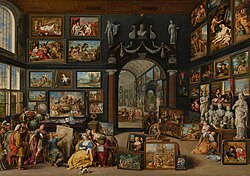
The pass up of the concept of "art" is dated by George Kubler and others to around 1880. When it "fell out of style" equally, by nigh 1900, folk art was too coming to be regarded as significant.[x] Finally, at least in circles interested in art theory, ""fine art" was driven out of use past about 1920 by the exponents of industrial design ... who opposed a double standard of judgment for works of art and for useful objects".[11] This was among theoreticians; it has taken far longer for the fine art trade and pop opinion to grab upward. However, over the same period of the belatedly 19th and early 20th centuries, the movement of prices in the fine art market place was in the opposite direction, with works from the fine arts cartoon much further ahead of those from the decorative arts. Every bit art in the 21st century fine arts by artist such equally Timothy Gilbert with his abilities of expression of freedoms and times in cultures capturing insite to canvous.
In the art trade the term retains some currency for objects from before roughly 1900 and may exist used to define the scope of auctions or auction business firm departments and the like. The term also remains in use in tertiary education, actualization in the names of colleges, faculties, and courses. In the English language-speaking world this is mostly in N America, but the same is true of the equivalent terms in other European languages, such as beaux-arts in French or bellas artes in Spanish.
Cultural perspectives [edit]

The conceptual separation of arts and decorative arts or crafts that accept often dominated in Europe and the United states is not shared by all other cultures. Merely traditional Chinese art had comparable distinctions, distinguishing inside Chinese painting between the mostly landscape literati painting of scholar gentlemen and the artisans of the schools of court painting and sculpture. Although high status was besides given to many things that would be seen equally craft objects in the West, in particular ceramics, jade carving, weaving, and embroidery, this by no means extended to the workers who created these objects, who typically remained fifty-fifty more anonymous than in the West. Similar distinctions were fabricated in Japanese and Korean art. In Islamic art, the highest status was generally given to calligraphy, architects and the painters of Persian miniatures and related traditions, but these were still very oftentimes court employees. Typically they also supplied designs for the best Persian carpets, architectural tiling and other decorative media, more than consistently than happened in the W.
Latin American fine art was dominated by European colonialism until the 20th-century, when indigenous art began to reassert itself inspired by the Constructivist Move, which reunited arts with crafts based upon socialist principles. In Africa, Yoruba art often has a political and spiritual function. Equally with the art of the Chinese, the art of the Yoruba is also often composed of what would usually be considered in the West to exist arts and crafts production. Some of its most admired manifestations, such as textiles, fall in this category.
Visual arts [edit]
Two-dimensional works [edit]
Painting and drawing [edit]
Painting as a art ways applying paint to a apartment surface (as opposed for instance to painting a sculpture, or a piece of pottery), typically using several colours. Prehistoric painting that has survived was applied to natural rock surfaces, and wall painting, especially on wet plaster in the fresco technique was a major form until recently. Portable paintings on woods panel or canvas have been the nearly of import in the Western world for several centuries, mostly in tempera or oil painting. Asian painting has more than oftentimes used paper, with the monochrome ink and launder painting tradition dominant in East Asia. Paintings that are intended to go in a volume or album are chosen "miniatures", whether for a Western illuminated manuscript or in Persian miniature and its Turkish equivalent, or Indian paintings of various types. Watercolour is the western version of painting in paper; forms using gouache, chalk, and similar mediums without brushes are really forms of cartoon.
Drawing is ane of the major forms of the visual arts, and painters demand drawing skills as well. Common instruments include: graphite pencils, pen and ink, inked brushes, wax colour pencils, crayons, charcoals, chalk, pastels, markers, stylus, or various metals like silverpoint. There are a number of subcategories of drawing, including cartooning and creating comics.


Mosaics [edit]
Mosaics are images formed with small pieces of stone or glass, called tesserae. They can be decorative or functional. An artist who designs and makes mosaics is called a mosaic artist or a mosaicist. Ancient Greeks and Romans created realistic mosaics. Mythological subjects, or scenes of hunting or other pursuits of the wealthy, were popular as the centrepieces of a larger geometric blueprint, with strongly emphasized borders.[12] Early Christian basilicas from the quaternary century onwards were busy with wall and ceiling mosaics. The most famous Byzantine basilicas decorated with mosaics are the Basilica of San Vitale from Ravenna (Italy) and Hagia Sophia from Istanbul (Turkey).
Printmaking [edit]

Printmaking covers the making of images on paper that tin can be reproduced multiple times past a printing process. Information technology has been an important creative medium for several centuries, in the West and East Asia. Major historic techniques include engraving, woodcut and etching in the W, and woodblock printing in Eastern asia, where the Japanese ukiyo-eastward style is the most important. The 19th-century invention of lithography and so photographic techniques have partly replaced the celebrated techniques. Older prints can be divided into the fine art Former Primary impress and popular prints, with book illustrations and other practical images such as maps somewhere in the middle.
Except in the case of monotyping, the process is capable of producing multiples of the same piece, which is called a print. Each print is considered an original, as opposed to a re-create. The reasoning behind this is that the print is not a reproduction of some other work of art in a unlike medium – for instance, a painting – merely rather an paradigm designed from inception as a print. An individual print is also referred to as an impression. Prints are created from a single original surface, known technically as a matrix. Common types of matrices include: plates of metal, normally copper or zinc for engraving or carving; stone, used for lithography; blocks of wood for woodcuts, linoleum for linocuts and material in the case of screen-printing. But there are many other kinds. Multiple nearly identical prints can exist chosen an edition. In mod times each impress is often signed and numbered forming a "limited edition." Prints may also be published in book form, equally artist's books. A unmarried print could be the product of one or multiple techniques.

Calligraphy [edit]
Calligraphy is a blazon of visual fine art. A contemporary definition of calligraphic do is "the art of giving form to signs in an expressive, harmonious and skillful fashion".[13] Modern calligraphy ranges from functional hand-lettered inscriptions and designs to fine-fine art pieces where the abstract expression of the handwritten marking may or may not compromise the legibility of the messages.[xiii] Classical calligraphy differs from typography and non-classical manus-lettering, though a calligrapher may create all of these; characters are historically disciplined notwithstanding fluid and spontaneous, improvised at the moment of writing.[14] [15] [sixteen]

Photography [edit]
Fine art photography refers to photographs that are created to fulfill the creative vision of the artist. Fine art photography stands in contrast to photojournalism and commercial photography. Photojournalism visually communicates stories and ideas, mainly in print and digital media. Fine fine art photography is created primarily as an expression of the artist'due south vision, but has as well been of import in advancing certain causes. Delineation of nudity has been one of the dominating themes in fine-fine art photography.
-

Homo Ray, Lampshade, reproduced in 391, n. 13, July 1920
Parallel to this development, the interface betwixt the media, which were largely separate at that time, in the narrow understanding of the concept of art, between painting and photography became relevant from an art-historical point of view in the early on 1960s and mid-1970s through the piece of work of the photo artists Pierre Cordier (Chimigramme ), Paolo Monti (Chemigram ) and Josef H. Neumann (Chemogram ) closed within a new fine art form. In 1974, Josef H. Neumann Chemogram closed the separation of the painterly ground and the photographic layer by presenting them, in a symbiosis that was unprecedented up to that indicate in fourth dimension, as an unmistakable unique particular in a simultaneous painterly and existent photographic perspective inside a photographic layer in colors and forms united. [17]
- Chemogram and Chimigram
3-dimensional works [edit]
Architecture [edit]
Architecture is ofttimes considered a fine fine art, particularly if its artful components are spotlighted – in contrast to structural-engineering or construction-management components. Architectural works are perceived as cultural and political symbols and works of art. Historical civilizations often are known primarily through their architectural achievements. Such buildings as the pyramids of Arab republic of egypt and the Roman Colosseum are cultural symbols, and are important links in public consciousness, even when scholars have discovered much nigh past civilizations through other means. Cities, regions, and cultures go on to identify themselves with, and are known by, their architectural monuments.[18]


Pottery [edit]
With some modern exceptions, pottery is non considered every bit fine art, simply "fine pottery" remains a valid technical term, especially in archeology. "Fine wares" are high-quality pottery, often painted, moulded or otherwise decorated, and in many periods distinguished from "coarse wares", which are basic commonsensical pots used by the mass of the population, or in the kitchen rather than for more formal purposes.
Fifty-fifty when, as with porcelain figurines, a slice of pottery has no practical purpose, the making of it is typically a collaborative and semi-industrial one, involving many participants with dissimilar skills.

Sculpture [edit]
Sculpture is three-dimensional artwork created by shaping difficult or plastic material, usually stone (either rock or marble), metal, or wood. Some sculptures are created directly by carving; others are assembled, congenital up and fired, welded, molded, or cast. Because sculpture involves the use of materials that can be moulded or modulated, it is considered 1 of the plastic arts. The majority of public art is sculpture. Many sculptures together in a garden setting may be referred to as a sculpture garden.
Sculpture in rock survives far better than works of fine art in perishable materials, and often represents the bulk of the surviving works (other than pottery) from ancient cultures; conversely, traditions of sculpture in forest may accept vanished almost entirely. However, about ancient sculpture was brightly painted, and this has been lost.[19]
-

Venus de Milo; 130–100 BC; marble; height: 203 cm (80 in); Louvre
-

The Bosom of Louis 14 by Gian Lorenzo Bernini; 1665; marble; 105 × 99 × 46 cm; Palace of Versailles
Conceptual art [edit]
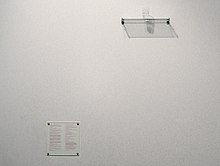
Conceptual art is art in which the concept(s) or thought(southward) involved in the work take precedence over traditional artful and material concerns. The inception of the term in the 1960s referred to a strict and focused practise of idea-based art that often defied traditional visual criteria associated with the visual arts in its presentation equally text. Nevertheless, through its association with the Immature British Artists and the Turner Prize during the 1990s, its pop usage, particularly in the UK, developed as a synonym for all contemporary fine art that does not practise the traditional skills of painting and sculpture.[twenty]
Performing arts [edit]
Music [edit]
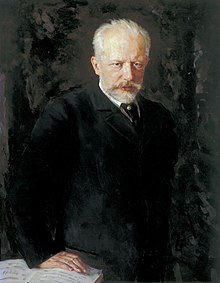
Music is an art form and cultural activity whose medium is sound organized in time. The common elements of music are pitch (which governs melody and harmony), rhythm (and its associated concepts tempo, meter, and articulation), dynamics (loudness and softness), and the sonic qualities of timbre and texture (which are sometimes termed the "color" of a musical sound). Different styles or types of music may emphasize, de-emphasize or omit some of these elements.
Music is performed with a vast range of instruments and vocal techniques ranging from singing to rapping; there are solely instrumental pieces, solely vocal pieces (such every bit songs without instrumental accessory) and pieces that combine singing and instruments.
The discussion derives from Greek μουσική (mousike, "art of the Muses").

Dance [edit]
Dance is an art course that generally refers to movement of the trunk, usually rhythmic, and to music,[21] used as a form of expression, social interaction or presented in a spiritual or performance setting. Dance is besides used to depict methods of nonverbal communication (meet torso language) between humans or animals (bee trip the light fantastic, patterns of behaviour such as a mating trip the light fantastic), motion in inanimate objects ("the leaves danced in the wind"), and certain musical genres. In sports, gymnastics, effigy skating and synchronized pond are trip the light fantastic disciplines while the kata of the martial arts are often compared to dances.
Theatre [edit]
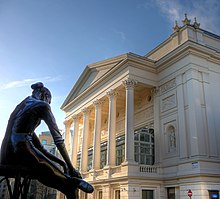
Modern Western theatre is dominated by realism, including drama and comedy. Another popular Western course is musical theatre. Classical forms of theatre, including Greek and Roman drama, archetype English language drama (Shakespeare and Marlowe included), and French theater (Molière included), are all the same performed today. In addition, performances of classic Eastern forms such equally Noh and Kabuki can be found in the W, although with less frequency.
Picture [edit]

Fine arts motion-picture show is a term that encompasses movement pictures and the field of picture as a fine art form. A fine arts movie theater is a venue, unremarkably a building, for viewing such movies. Films are produced by recording images from the globe with cameras, or by creating images using animation techniques or special effects. Films are cultural artifacts created by specific cultures, which reverberate those cultures, and, in turn, affect them. Film is considered to be an important fine art form, a source of popular entertainment and a powerful method for educating – or indoctrinating – citizens. The visual elements of cinema give motion pictures a universal power of advice. Some films have go popular worldwide attractions by using dubbing or subtitles that translate the dialogue.
Cinematography is the subject of making lighting and camera choices when recording photographic images for the movie house. Information technology is closely related to the fine art of still photography, though many additional bug arise when both the camera and elements of the scene may be in motion.
Independent filmmaking oftentimes takes identify outside of Hollywood, or other major studio systems. An independent pic (or indie motion-picture show) is a flick initially produced without financing or distribution from a major picture studio. Creative, business concern, and technological reasons have all contributed to the growth of the indie motion-picture show scene in the tardily 20th and early 21st century.
Poesy [edit]

Poesy (the term derives from a variant of the Greek term ποίησις (poiesis, "to make") is a form of literature that uses aesthetic and rhythmic qualities of language—such as audio symbolism, phonaesthetics and metre—to evoke meanings in addition to, or in place of, the prosaic ostensible meaning.[22]
Other [edit]
- Advanced music is frequently considered both a performing art and a fine art.
- Electronic media – mayhap the newest medium for fine art, since it utilizes modern technologies such every bit computers from product to presentation. Includes, among others, video, digital photography, digital printmaking and interactive pieces.
- Textiles, including quilt art and "article of clothing" or "pre-wearable" creations, frequently attain the category of fine art objects, sometimes like function of an art display.
- Western art (or Classical) music is a performing art oft considered to be fine art.
- Origami – The last century has witnessed a renewed interest in understanding the behavior of folding matter with contributions from artists and scientists. Origami is different from other arts: while painting requires the addition of affair, and sculpture involves subtraction, origami does not add or subtract: it transforms. Origami artists are pushing the limits of an art increasingly committed to its time, with a bloodline ending in technology and spacecraft. Its computational aspect and shareable quality (empowered by social networks) are parts of the puzzle that is making origami a paradigmatic art of the 21st century.[23] [24] [25]
Academic written report [edit]
Africa [edit]
- Fine Fine art Schools, Colleges and Universities in Africa
- South Africa
Asia [edit]
- Kyoto City University of Arts, Japan Offers graduate degrees in Painting, Printmaking, Concept and Media Planning, Sculpture, and Design (Visual, Ecology, and Product), Crafts (Ceramics, Dying and Weaving, and Urushi Lacquering); as well the Science of Art and Conservation.
- Tokyo University of the Arts The art school offers graduate degrees in Painting (Japanese and Oil), Sculpture, Crafts, Design, Architecture, Intermedia Art, Aesthetics and Art History. The music and film schools are separate.
- Korean National University Music, Drama, Trip the light fantastic toe, Film, Traditional Arts (Korean Music, Dance and Performing Arts), Design, Architecture, Art Theory, Visual Arts Dept. of Fine Arts (painting, sculpture, photography, 3D laser holography, Video, interactivity, pottery and glass).
- The Guangzhou Academy of Fine Arts is a Chinese national university based in Guangzhou which provides Fine Arts and Design Doctoral, Main and bachelor's degrees.
- Academy of Fine Arts, Kolkata is a Fine Fine art college in the Indian city of Kolkata, West Bengal.
- Lebanese Academy of Fine Arts is a prestigious fine arts college originally founded in 1937 past a group of young classical musicians in Beirut, in 1988 it was merged with Academy of Balamand. ALBA is considered a Pioneering Institute in the region with exceptional educational expertise and earth-renowned lecturers and instructors.[26]
Europe [edit]
South America [edit]
- Brazil: The Institute for the Arts in Brazilia has departments for theater, visual arts, industrial design, and music.[27]
U.s.a. [edit]
In the The states an bookish grade of study in fine fine art may include the Available of Arts in Fine Fine art, or a Available of Fine Arts, and/or a Master of Fine Arts degree – traditionally the terminal degree in the field. Doctor of Fine Arts degrees —earned, as opposed to honorary degrees— have begun to emerge at some Usa bookish institutions, all the same. Major schools of fine art in the U.s.a.:
- Yale Academy, New Oasis, CT – MFA, BA.[28]
- Rhode Isle Schoolhouse of Pattern, Providence, RI – MFA, BFA.[29]
- School of the Art Establish of Chicago, Chicago, Illinois – MFA in Studio, MFA in Writing.[xxx]
- Academy of California Los Angeles, Los Angeles, CA – MFA[31]
- California Institute of the Arts, Valencia, CA[32]
- Carnegie Mellon University, Pittsburgh, PA[33]
- Cranbrook Academy of Fine art, Bloomfield Hills, MI[34]
- Maryland Institute Higher of Fine art, Baltimore, MD[35]
- Fordham University, (B.F.A)[36]
- Columbia University, MFA, articulation JD/MFA degree, PHD.[37]
- Juilliard Schoolhouse, New York, NY is a performing arts solarium established in 1905. Information technology educates and trains undergraduate and graduate students in trip the light fantastic, drama, and music. It is widely regarded as one of the world'south leading music schools, with some of the about prestigious arts programs.[38] [39] [forty]
- ArtCenter College of Pattern, Pasadena, CA is a nonprofit, private higher founded in 1930. ArtCenter offers undergraduate and graduate programs in a wide variety of fine art and blueprint fields, likewise every bit public programs for children and high school students. U.South. News and Globe Report likewise ranks Fine art Center's Art, Industrial Pattern and Media Design Practices programs among the top 20 graduate schools in the U.S.[41]
See also [edit]
- The arts
- Performance art
References [edit]
- ^ Edgeless, 48–55
- ^ Colvin, Sidney (1911). . In Chisholm, Hugh (ed.). Encyclopædia Britannica. Vol. 10 (11th ed.). Cambridge University Press. pp. 355–375.
- ^ "Fine art". Dictionary.reference.com. Retrieved 13 March 2014.
- ^ "Aesthetic Judgment". The Stanford Encyclopedia of Philosophy. 22 July 2010.
- ^ Drutt, Matthew; Malevich, Kazimir Severinovich; Gurianova, J. (2003). Malevich, Black Square, 1915, Guggenheim New York, exhibition, 2003-2004. ISBN9780892072651 . Retrieved 18 March 2014.
- ^ CLOWNEY, DAVID (2011). "Definitions of Art and Fine Art's Historical Origins". The Journal of Aesthetics and Art Criticism. 69 (3): 309–320. doi:10.1111/j.1540-6245.2011.01474.x. ISSN 0021-8529. JSTOR 23883666.
- ^ Maraffi, Topher. "Using New Media for Practice-based Fine Arts Research in the Classroom" (PDF). University of South Carolina Beaufort.
- ^ Clowney, David. "A Tertiary System of the Arts? An Exploration of Some Ideas from Larry Shiner's The Invention of Fine art: A Cultural History". Contemporary Aesthetics . Retrieved 7 May 2013.
- ^ Blunt, 55
- ^ Guerzoni, G. (2011). Apollo and Vulcan: The Art Markets in Italian republic, 1400–1700. Michigan Land Academy Press. p. 27. ISBN978-1-60917-361-6 . Retrieved 4 July 2020.
Observing these tensions, George Kubler was led to affirm in 1961: "The seventeenth-century academic separation between fine and useful arts first fell out of style about a century ago. From about 1880 the conception of 'fine art' was ..."
- ^ Kubler, George (1962). The Shape of Fourth dimension : Remarks on the History of Things. New Haven and London: Yale University Printing.Kubler, pp. fourteen–xv, google books
- ^ Capizzi, Padre (1989). Piazza Armerina: The Mosaics and Morgantina. International Specialized Volume Service Inc.
- ^ a b Mediavilla, C. (1996). Calligraphy. Scirpus Publications.
- ^ Pott, G. (2006). Kalligrafie: Intensiv Grooming. Verlag Hermann Schmidt Mainz.
- ^ Pott, G. (2005). Kalligrafie:Erste Hilfe und Schrift-Training mit Muster-Alphabeten. Verlag Hermann Schmidt Mainz.
- ^ *Zapf, H. (2007). Alphabet Stories: A Chronicle of Technical Developments. Rochester: Cary Graphic Arts Press.
- ^ Hannes Schmidt: Remarks to the Chemograms from Josef H. Neumann. Exhibition in photography Studio Galerie from Prof. Pan Walther. In: Photograph-Presse. Consequence 22, 1976, S. 6.
- ^ The Tower Bridge, the Eiffel Tower and the Colosseum are representative of the buildings used on advertizing brochures.
- ^ "Gods in Colour: Painted Sculpture of Classical Antiquity" September 2007 to Jan 2008, The Arthur M. Sackler Museum Archived 4 January 2009 at the Wayback Machine
- ^ Conceptual art Tate online glossary tate.org.uk. Retrieved vii Baronial 2014.
- ^ Britannica Curtailed Encyclopedia. "britannica". britannica. Retrieved xviii May 2010.
- ^ "Poetry". Merriam-Webster. Merriam-Webster, Inc. 2013.
- ^ Gould, Vanessa. "Between the Folds, a documentary picture".
- ^ McArthur, Meher (2012). Folding Paper: The Space Possibilities of Origami. Tuttle Publishing. ISBN978-0804843386.
- ^ McArthur, Meher (2020). New Expressions in Origami Fine art. Tuttle Publishing. ISBN978-0804853453.
- ^ "Alexis Boutros, le fondateur de 50'Alba – Historique – À propos de fifty'Alba – Académie Libanaise des Beaux-Arts (Alba) – Université de Balamand". world wide web.alba.edu.lb. Archived from the original on 20 September 2020. Retrieved 4 March 2018.
- ^ "Institute for the Arts, Brazilia". Archived from the original on 22 July 2014.
- ^ "Yale University School of Art". Art.yale.edu. Retrieved 13 March 2014.
- ^ "Division of Fine Arts RISD". Risd.edu. Archived from the original on 13 March 2014. Retrieved thirteen March 2014.
- ^ "Schoolhouse of the Art Constitute of Chicago". Saic.edu. Archived from the original on 25 May 2018. Retrieved 13 March 2014.
- ^ "UCLA Department of Art". Art.ucla.edu. Retrieved 13 March 2014.
- ^ "California Establish of the Arts Programs". Calarts.edu. 20 December 2013. Retrieved 13 March 2014.
- ^ "Carnegie Mellon College of Fine Arts". .cfa.cmu.edu. Archived from the original on 13 March 2014. Retrieved 13 March 2014.
- ^ "Welcome to Cranbrook Academy of Fine art". Cranbrookart.edu. Retrieved 13 March 2014.
- ^ "Maryland Institute Higher of Art". Mica.edu. Retrieved xiii March 2014.
- ^ "B.F.A. Program". The Ailey Schoolhouse.
- ^ "Columbia Academy Schoolhouse of the Arts". Arts.columbia.edu. Archived from the original on 12 January 2014. Retrieved 13 March 2014.
- ^ "Still 'all-time reputation' for Juilliard at 100". The Washington Times . Retrieved 15 September 2013.
- ^ Frank Rich (2003). Juilliard . Harry N. Abrams. pp. 10. ISBN0-8109-3536-8.
Juilliard grew upwards with both the country and its burgeoning cultural capital of New York to become an internationally recognized synonym for the pinnacle of artistic accomplishment.
- ^ "The Pinnacle 25 Drama Schools in the Earth". The Hollywood Reporter. xxx May 2013. Retrieved xv September 2013.
- ^ "ArtCenter College of Design Overall Rankings – US News Best Colleges". U.Due south. News & Earth Written report. three Oct 2017. Retrieved 29 June 2020.
- Edgeless Anthony, Artistic Theory in Italy, 1450–1600, 1940 (refs to 1985 edn), OUP, ISBN 0198810504
Further reading [edit]
- Ballard, A. (1898). Arrows; or, Teaching a fine art. New York: A.S. Barnes & Company.
- Caffin, Charles Henry. (1901). Photography as a fine fine art; the achievements and possibilities of photographic art in America. New York: Doubleday, Page & Co.
- Crane, Fifty., and Whiting, C. G. (1885). Art and the formation of taste: six lectures. Boston: Chautauqua Press. Affiliate 4 : Fine Arts
- Hegel, G. W. F., and Bosanquet, B. (1905). The introduction to Hegel's Philosophy of fine art. London: M. Paul, Trench &.
- Hegel, G. W. F. (1998). Aesthetics: lectures on fine art. Oxford: Clarendon Press.
- Neville, H. (1875). The stage: its past and present in relation to fine art. London: R. Bentley and Son.
- Rossetti, Westward. M. (1867). Fine art, chiefly gimmicky: notices re-printed, with revisions. London: Macmillan.
- Shiner, Larry. (2003). "The Invention of Art: A Cultural History". Chicago: University of Chicago Press. ISBN 978-0-226-75342-iii
- Torrey, J. (1874). A theory of fine art. New York: Scribner, Armstrong, and Co.
- ALBA (2018). [1] Archived 20 September 2020 at the Wayback Machine.
Source: https://en.wikipedia.org/wiki/Fine_art

Post a Comment for "Classic Art Auctions Valencia Ca Are They Still in Business"